
Criminal Cases in Monroe County Courts
Monroe County Superior Court is the felony trial court. It has exclusive original jurisdiction over felonies, apart from juvenile matters, and may also hear misdemeanors. Monroe belongs to the Towaliga Judicial Circuit with Butts and Lamar counties. The Superior Court clerk keeps indictments, accusations, docket entries, pleas, judgments, and sentencing orders at 1 Courthouse Square in Forsyth. The counter is open Monday through Friday from 8 a.m. to 5 p.m.; call 478-994-7022.
The local split matters. Monroe County directs traffic and misdemeanor criminal inquiries to Probate Court at the same courthouse, 478-994-7036. Magistrate Court handles arrest warrants, first appearances, commitment matters, and civilian pre-warrant requests at 143 L. Cary Bittick Drive. Forsyth Municipal Court keeps city citations, municipal warrants, fines, subpoenas, and its own court records. Juvenile delinquency records generally are restricted. A citation, warrant, calendar, or jail charge should name the court and save a request from going to the wrong counter.
Four Monroe County Court Counters
“The courthouse” is not one criminal-record desk. Match the kind of matter to its custodian before asking for copies.
| Court | Record role | Official contact |
|---|---|---|
| Superior Court | Felony files and some misdemeanors | 1 Courthouse Square; 478-994-7022 |
| Probate Court | County traffic and misdemeanor inquiries | 1 Courthouse Square; 478-994-7036 |
| Magistrate Court | Warrants, first appearances, commitment matters | 143 L. Cary Bittick Drive; 478-994-7018 |
| Forsyth Municipal Court | City ordinance and traffic cases | City Hall channel; confirm the current calendar |
The county’s official Superior Court page also shows the court’s jurisdiction, calendar links, hours, and clerk contact.
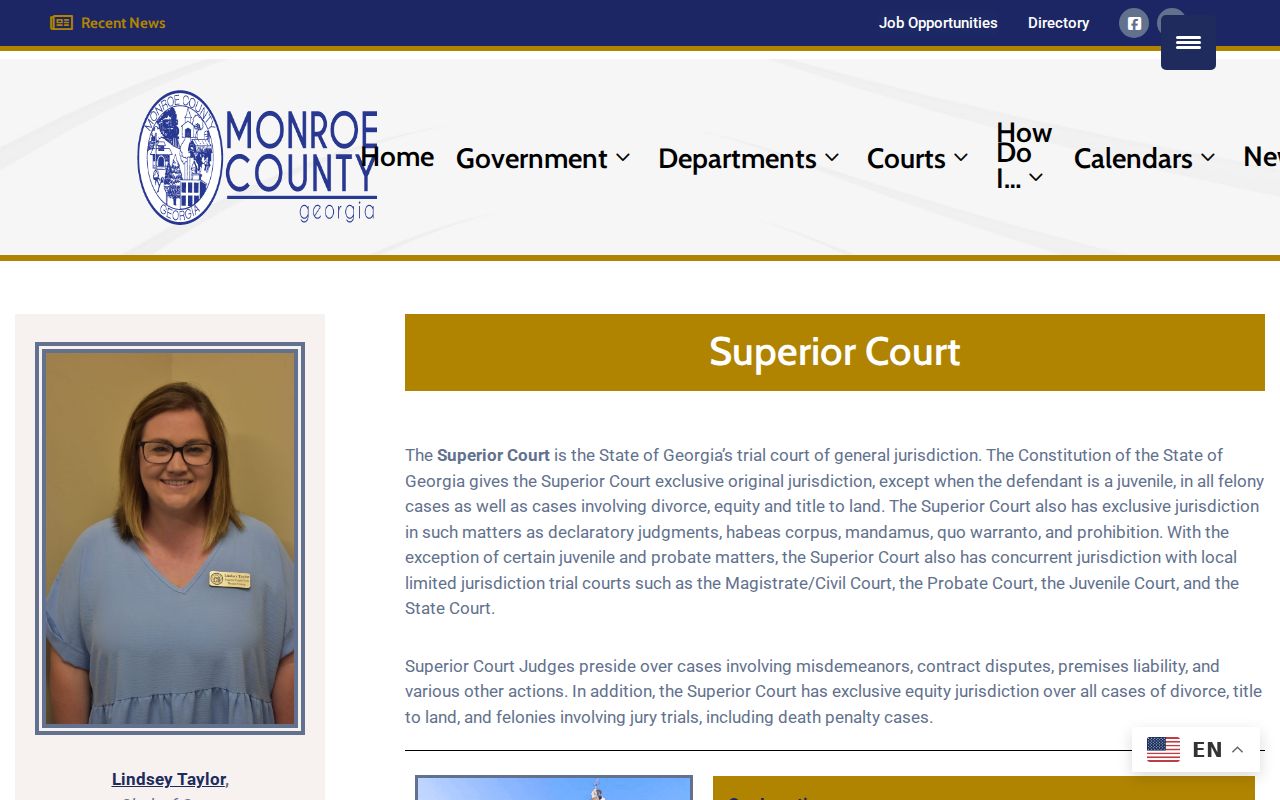
That page is the sound starting point for a filed felony case, but a calendar link is only a clue about a scheduled event.
How to Search Case Records
Georgia has no single free, comprehensive judiciary-owned criminal search. The Georgia Courts E-Access directory routes people to participating court providers, often with an account. Monroe’s clerk page links PeachCourt for civil e-filing and copies, but does not promise complete public criminal coverage there. Use this order:
- Read the court name and case, warrant, or ticket number on the source document.
- For a felony, call or visit the Superior Court clerk and ask for the docket plus a named filing.
- Use Probate Court for county traffic or misdemeanor matters, Magistrate Court for warrant and first-appearance records, and Forsyth Municipal Court for city citations.
- Check the official E-Access directory for any available electronic route, without assuming that every filing is online.
- Ask the correct clerk about copies, certification, archive retrieval, and mailing charges.
The state judiciary’s electronic-access resource illustrates why court-by-court verification is needed.
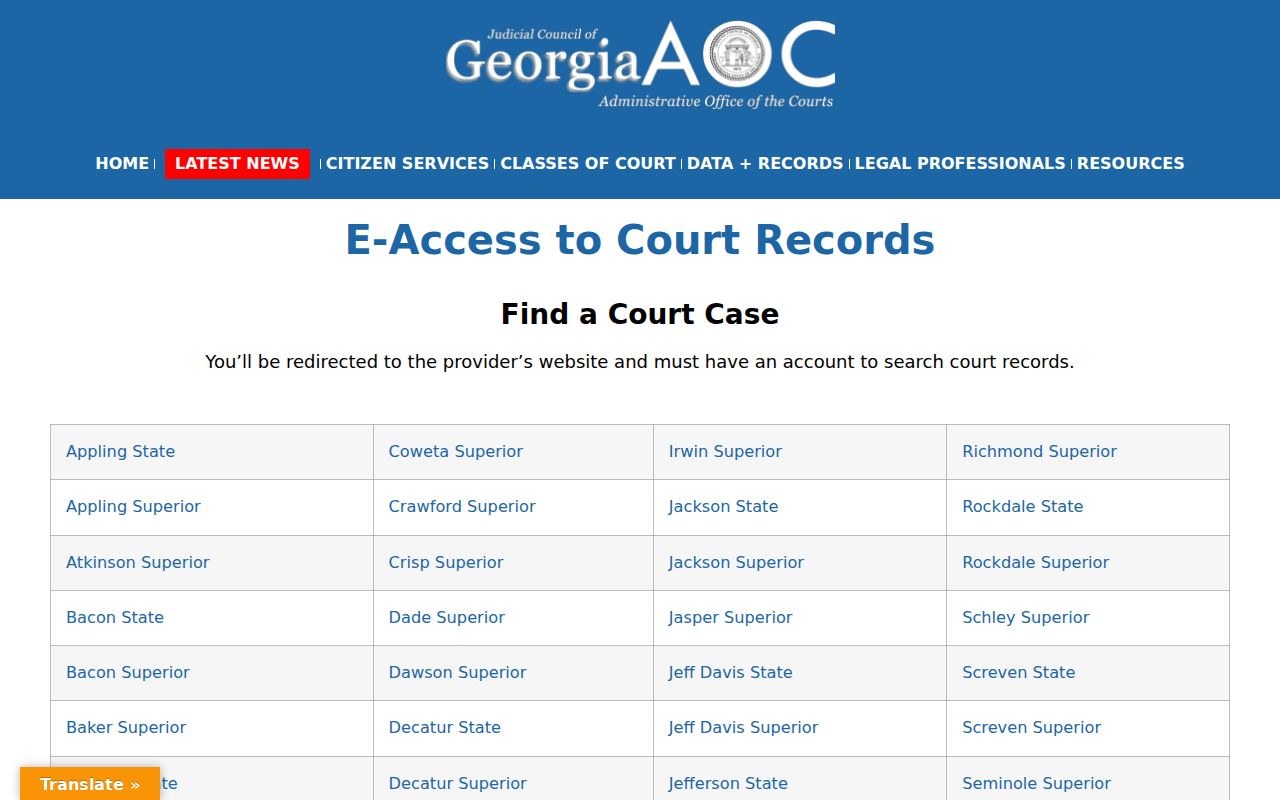
It is a directory layer, not proof that a Monroe County criminal file is complete online.
Monroe Criminal Calendar Search Fields
Monroe’s public criminal non-jury calendar can help identify a current hearing. It is not a full case database. Searchers should copy the warrant or ticket number, offense, and hearing type, then request the underlying file from the clerk.
| Calendar field | Use | Limit |
|---|---|---|
| Court and county | Confirms venue | Does not prove jurisdiction over every charge |
| Hearing date and time | Shows the scheduled event | May later change |
| Warrant or ticket number | Strong clerk lookup key | Not a full docket number in every matter |
| Offense and attorney | Helps distinguish entries | Charge may change |
| Hearing or motion type | Explains the calendar setting | Not the final outcome |
The sample does not provide a full docket history, pleadings, financial ledger, birth date, victim details, sentence, or disposition. A motion for bond or commitment hearing is an event, not a judgment.
What the Case File Shows
A Monroe County court file documents the prosecution after filing. It can differ from the first allegations shown in a booking record because the prosecutor may add, amend, replace, or dismiss counts.
| Case Number and Court | Identifies the clerk, venue, and specific prosecution. |
|---|---|
| Charging Document | An indictment or accusation states the charges actually filed. |
| Docket Entries | Chronological filings, hearings, motions, and court actions. |
| Hearing Dates | Calendar settings for arraignment, motions, trial, or sentencing. |
| Disposition and Judgment | Shows dismissal, nolle prosequi, acquittal, plea, or verdict. |
| Sentence and Conditions | Records confinement, probation, fines, and other ordered terms. |
A GCIC history summarizes fingerprint-linked arrest cycles and reported outcomes. It normally does not contain the clerk’s motions, complete hearing trail, or financial ledger. For a disputed statewide entry, obtain a certified Monroe County disposition and ask the originating court or agency to transmit the correction.
Monroe Jail Charges Can Change
A jail row reflects the arresting officer’s allegations at booking. A prosecutor later decides what to file. The formal case may proceed by grand-jury indictment or, where Georgia law permits, accusation. Counts can be revised, merged, dismissed, or never filed. That is why the Monroe County arrest history and the court docket should be read together when tracing one event.
Outcome terms also require care. Nolle prosequi means the prosecutor declined to continue that charge at that time. It is not an acquittal. A dismissal ends the charge by court action, while an acquittal or not-guilty verdict resolves the merits for the accused. A guilty plea or verdict is ordinarily a conviction. First Offender treatment must be read with the actual order and Georgia law.
Stages of a Criminal Case
The record begins outside the clerk’s office. Law enforcement creates arrest papers and the jail books the person. A judicial officer reviews probable cause, custody, and bond. Prosecutors then decide the filed counts. Arraignment records the plea, followed by discovery, motions, calendar calls, and other pretrial work. The case ends through dismissal, nolle prosequi, plea, bench trial, or jury verdict. A judgment and sentence follow an adjudication of guilt, while an appeal creates a separate record trail.
Case flow: Charges Filed › Arraignment › Pretrial › Plea or Trial › Disposition › Sentencing
The nearby U.S. District Court for the Middle District of Georgia handles federal cases, not Monroe County prosecutions.
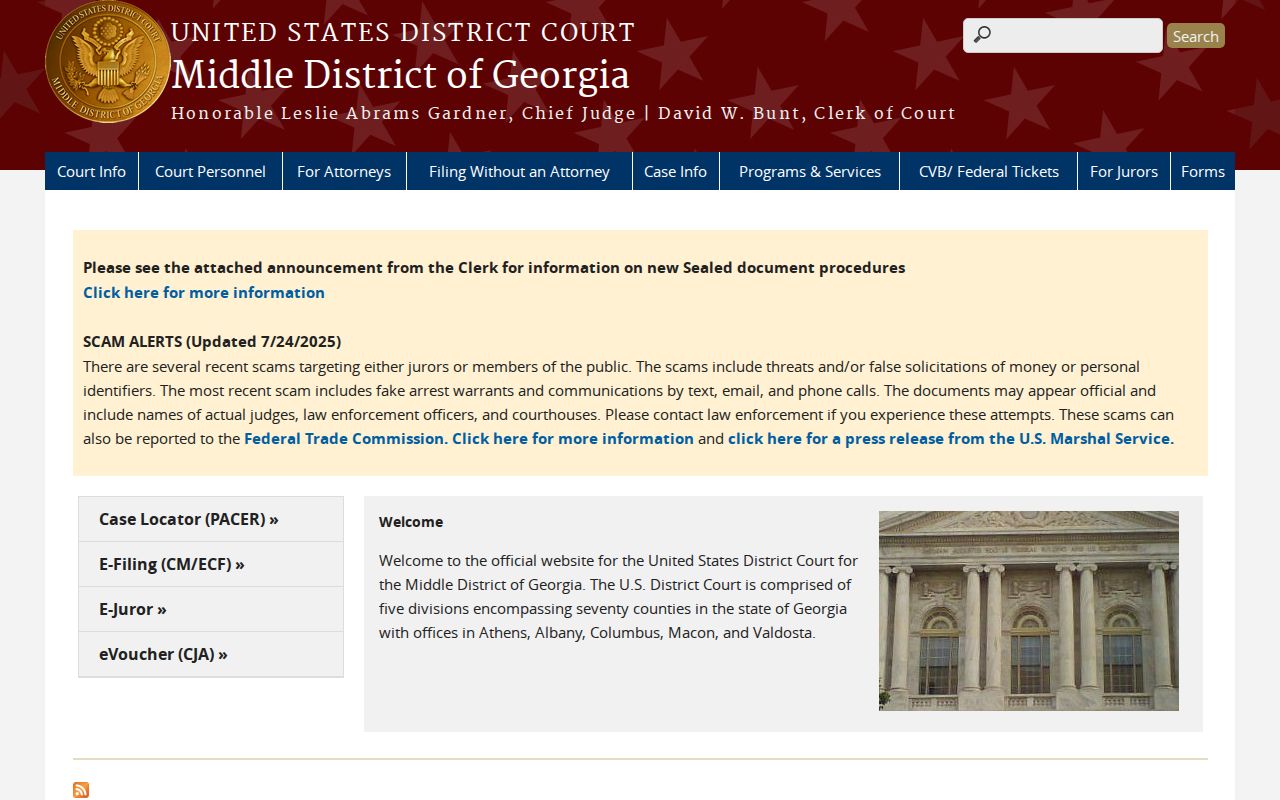
Federal docket material instead runs through the federal clerk and PACER.
Federal Court Cases Outside Monroe County
A federal charge tied to Monroe County does not appear as a county Superior Court prosecution. The Middle District of Georgia is the proper federal trial court. PACER is the federal registration and case-search system.
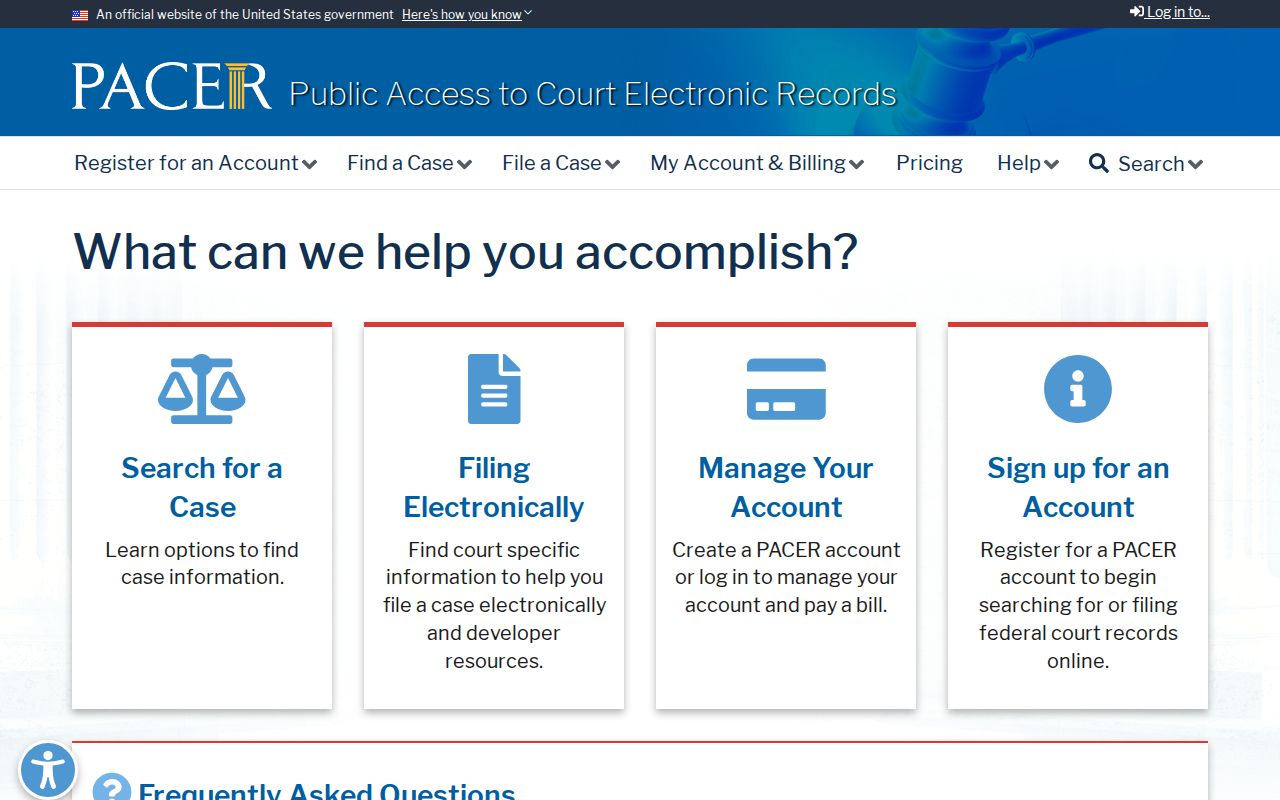
PACER’s docket is separate from Georgia’s court directories and the Monroe County clerk’s files. Search the court named on the charging paper rather than relying on one system.
Access and Restrictions
The Georgia Open Records Act favors access to public agency records unless an exemption applies, but court access also follows judicial rules and case-specific orders. Juvenile files, sealed material, protected victim data, confidential identifiers, and some active investigative content may be unavailable or redacted. A missing online result can also mean the file is old, archived, not digitized, under another spelling, or not yet indexed.
Ask the clerk whether a public paper file or terminal entry exists before concluding that no case exists. Georgia record restriction under O.C.G.A. §35-3-37 limits eligible GCIC dissemination but does not destroy the record. A separate court-sealing order may govern the clerk’s docket or images. Sheriff Central Records is not the fallback for court documents or dispositions; its official policy excludes both.
The Georgia Superior Court Clerks’ Cooperative Authority supplies statewide clerk resources.
Its statewide role does not replace a direct request to Monroe County’s clerk for a certified local criminal disposition.
Forsyth Municipal Court Records
Forsyth Municipal Court is a separate source for city ordinance and traffic matters. Its staff prepares and processes citations, warrants, fines, subpoenas, and court records. The city’s fiscal report recorded 2,446 Municipal Court cases in 2023, a workload measure rather than a crime rate.
The official Forsyth Municipal Court page provides the city lookup and contact route.
A city citation stays with this municipal clerk unless later proceedings create a distinct county court record.